Work package 3: Implementing FAIR principles in open education
This work package focusses on the usefulness (QR) of both the co-created materials (FAIR) and the co-creation process (CARE). What these abbreviations mean, and why they matter, is explained below.
Our aim is to help understand the importance of FAIR, CARE, and QR, and provide accessible, understandable, and effective resources to support in making co-creation materials and processes useful. We develop explanations, guidelines, flowcharts, and appropriate references for more background information, to support the co-creation of educational materials.
This team consists of Margreet Docter and Renske Voerman.
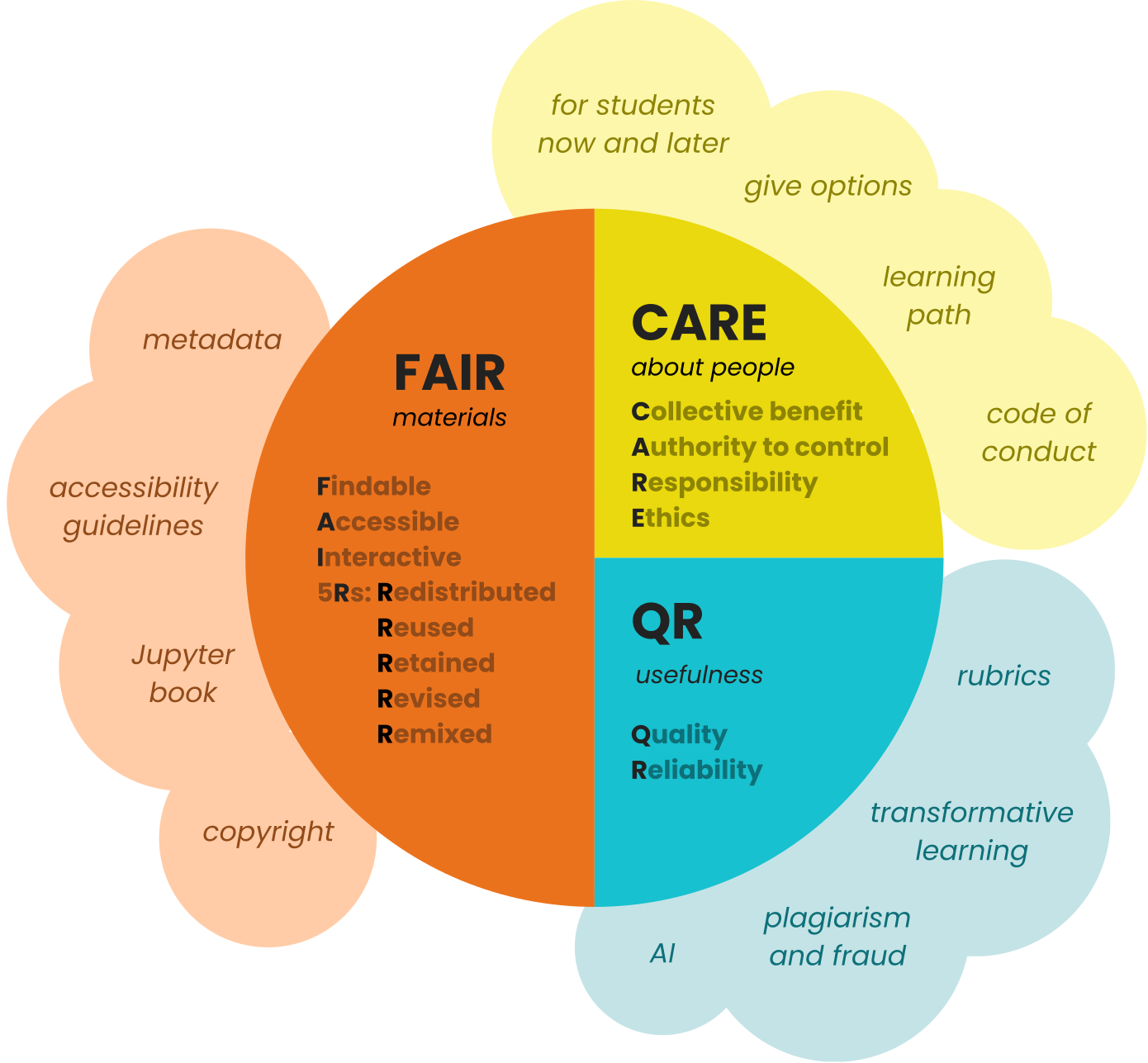
Diagram showing the definitions of FAIR, CARE and QR, as well as we’re implementing them in the COMBINE project.
FAIR-QR: why should we CARE? [1]
In a co-creation project, as a student you are not just learning from educational materials—you are helping create them. FAIR-CARE-QR principles ensure that your contributions are useful, reusable, and impactful for others.
While most people may be familiar with FAIR in data management, in co-creative education it focusses on the technical quality of materials which need to be Findable, Accessible, Interactive, and the 5R’s (like Reuse). In addition, QR (Quality and Reliability) ensures that educational materials are trustworthy and valuable.
While FAIR-QR deals mostly with materials, CARE (Collective Benefit, Authority to Control, Responsibility, Ethics) adds to the human perspective: how we collaborate, share, and take responsibility in the co-creation process.
Below, each of these principles is explained and linked to what it means for your role as a contributor.
FAIR
Findable: What’s the Deal with Metadata?
Why should you care? Metadata is your secret weapon for making your work shine in the digital world. It’s not just about you and your classmates; it opens the door for a global audience, from students to knowledge seekers everywhere. For your contributions to truly have an impact, they need to be easily discoverable by both people and search engines. Think of properly structured metadata as the key to a treasure chest of visibility, helping your work become part of the global knowledge network. Unlock your potential and make your mark.
Accessible: Think about your readers!
When learning, you benefit from materials that are clear, and easy to understand. In and after a cocreation context, your work will be used by people with different backgrounds, knowledge levels and abilities. That means what seems obvious to you may not be obvious to someone else.
Universal Learning Design (UDL) helps address this challenge. Instead of adapting to each individual learner afterwards, it encourages designing materials that work for as many people as possible. This includes supporting learners with diverse needs, such as neurodiversity, visual or hearing impairments, or lacking motor skills.
The Web Content Accessibility Guidelines (WCAG) provide practical rules to achieve this. In practice, this often means offering multiple ways to access information, like alt-text, video subtitles, and video replay.
Interactive: From passive to active learning
The materials developed in COMBINE are not meant to be static textbooks—they are designed to support active learning. This means students are not just consuming knowledge, but engaging with it, applying it, and improving it.
Interactivity happens at multiple levels:
readers actively work with the material,
authors reflect on and refine content,
students and teachers collaborate during co-creation.
During the interaction, the actual learning happens. By actively contributing, discussing, and explaining, you move from studying content to owning knowledge. Much of this interaction takes place during the co-creation process (see WP2)
5R’s: Reuse, Retained, Redistributed, Revised, Remixed
The 5R’s describe how educational materials can be used and improved over time:
Reuse: use existing materials in your own work
Retain: keep copies for your own use
Redistribute: share materials with others
Revise: improve or adapt content
Remix: combine materials into something new
In a co-creation project, reuse works in both directions: you build on work created by others, and future students may build on your contributions. To support this, clear agreements about ownership and reuse are essential. For example, work created by employees belongs to the university, and student contributions can be reused when a copyright agreement is signed.
A copyright agreement ensures proper crediting and referencing, such that your work can become part of real educational materials, and that others can safely reuse it. Your work does not disappear after grading anymore, but contributes to future education. In this way you build your portfolio, you gain recognition and impact future students.
Quality & Reliability: why does it matter?
Any material, and certainly educational materials, should meet clear quality standards in order to be useful. It should also be reliable: it should work well over time and remain accurate, understandable, and relevant to future users.
In this co-creation process, you play an important role in ensuring quality. Together with your peers and the teacher (who reviews and edits for publication), you make the content trustworthy and valuable. To do this well, it helps to build on established learning theories, such as constructivism, where learners are seen as active constructors of knowledge, not passive receivers. This idea is reflected in constructive alignment (making sure learning goals, activities, and assessments fit together, and Bloom’s taxonomy, which guides you from basic knowledge towards higher-order thinking.
Quality improves through iteration. Your work is not finished after the first cycle; through peer and teacher feedback, you revise your contribution. Each revision is a step towards higher-quality material.
Quality also means working with integrity. This includes two things: avoiding fraud and plagiarism, and using AI in a responsible and transparent way. Your work should be your own, properly supported and clearly documented.
Quality and reliability also apply to how your work (materials and process) is assessed. Clear rubrics should make the assessment fair, valid and consistent.
Finally, reliability goes beyond your course this year, as your work may be included in interactive online textbooks, where it can be updated and improved over time. This means your work will be used by future students; therefore it is worth getting it right.
CARE
The CARE principles were originally developed for indigenous contexts, but their ideas are useful wherever people, and not just data, matter. They address issues such as power imbalance, lack of control, and ensuring communities benefit from what is created. In COMBINE, CARE is applied to the co-creation process with students, supporting a way of working that is fair, respectful, and responsible.
Collective Benefit = why it matters
Imagine that the work you create as a student doesn’t just disappear into a grading folder—but actually lives on and helps others. Your assignments become part of a shared collection that future students can learn from, improve, and build on – so you’re not just working for a grade, but contributing to something meaningful.
This also makes learning more engaging and rewarding. You benefit from materials created by students before you, already refined and checked by teachers, giving you richer and more relatable resources. At the same time, by sharing these materials openly, your work helps students beyond TU Delft access high-quality learning without expensive textbooks – making education more accessible and inclusive.
Authority to Control = your control
You play an active role in shaping how your work is used, giving you real control over your contributions. While participation in creating learning materials is part of the course, you retain the right to decide whether your work is shared more widely—you can opt out of future publication within a month after the course ends. This ensures that contributing feels empowering rather than obligatory.
At the same time, the project is transparent and evidence-based. The data collected for research is not only used by researchers but also shared back with you, helping you see how this approach supports deeper understanding and motivation. Finally, you are clearly informed about what happens with your data: all information is handled responsibly, is anonymized before publication, and managed according to a clear data plan, so that your participation remains both safe and trustworthy.
Responsibility = how you act
You contribute to a learning environment built on positive, respectful, and trusted collaboration. As you work with peers and teachers, feedback is focused on helping each other improve—constructively strengthening both the materials and the way you work together.
At the same time, the process is not only about the final outcome but also about your development. By participating, you build skills and expand your capabilities, so the experience adds lasting value beyond the specific project.
Responsibility also means making the content accessible and inclusive. Materials are designed to be understandable and respectful of different perspectives. While English is widely used, options to engage with content in your own language are found in the use of Google translate, AI tools, or the more advanced (already existing option) interactive book in multiple languages.
Ethics = how it stays fair and safe
You participate in a process designed to maximise benefits while minimising risks. Your work is handled with care: it is anonymized before sharing, separated from grading, and—when published—properly attributed so you receive recognition for your contributions. At the same time, you benefit from a more engaging learning experience that supports deeper understanding, while your work continues to help future students.
Fairness is central throughout. Co-creation ensures everyone has the opportunity to contribute and benefit, without creating unfair grade advantages where participation is optional. Effort, responsibility, and attribution are distributed as evenly as possible, so contributions are recognized appropriately.
Your work also contributes to a growing body of materials intended for future use. Proper attribution keeps your role visible, while the collaborative nature of co-creation—drawing on multiple contributors—helps ensure the materials are balanced, reliable, and responsibly developed.
Made it engaging with CoPilot / Grammarly.